The night sky over Pasadena when Curiosity landed on Mars
Late on August 5, 2012, a room of engineers at NASA's Jet Propulsion Laboratory in Pasadena stood up and cheered. The signal had arrived: the Curiosity rover was safe on the floor of Gale Crater, on Mars.
Curiosity is about the size of a small car. It was too heavy to land on airbags like the rovers before it, so a rocket-powered sky crane lowered it on cables to the ground.
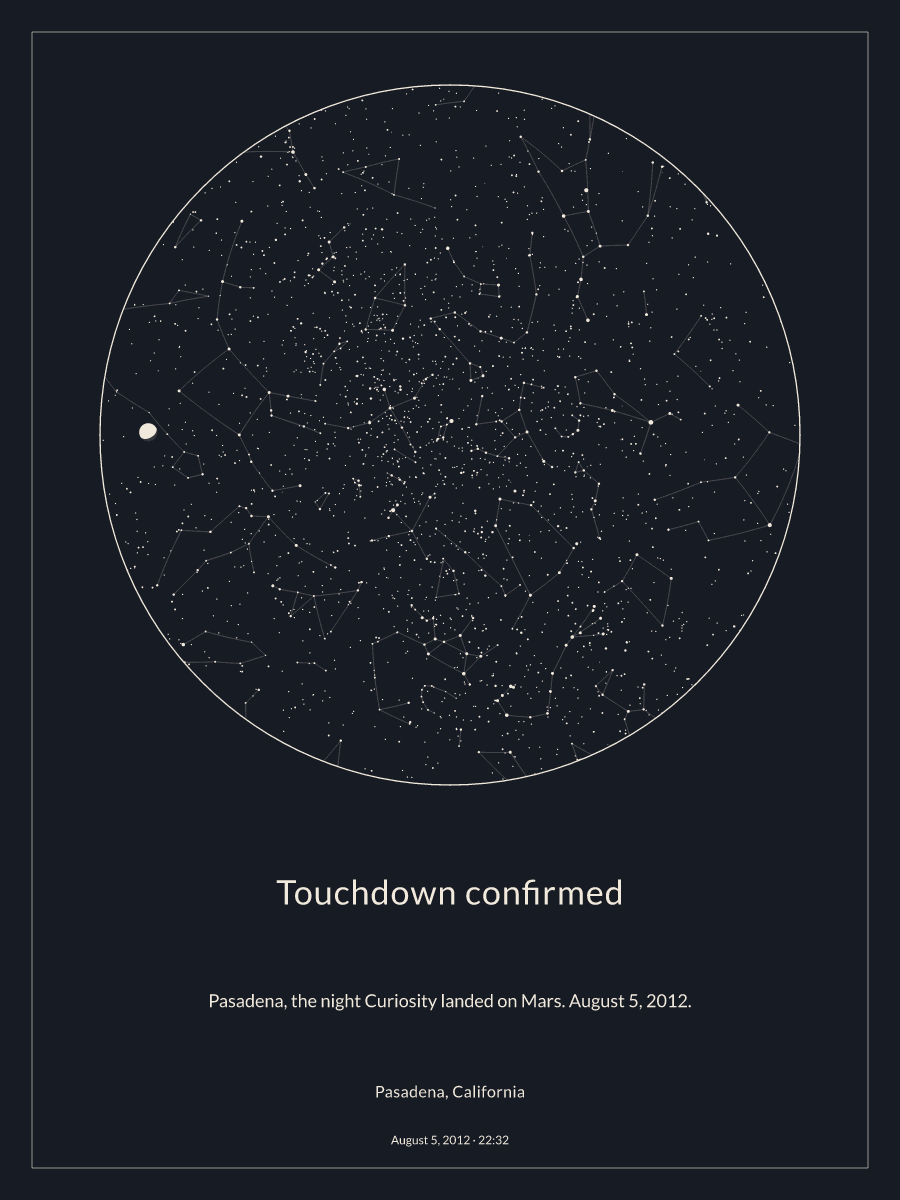
The sky above Pasadena, California on August 5, 2012
The sky was fully dark. There was a waning gibbous Moon in the sky, 82% lit. It stood 9° above the horizon in the east, in the constellation Pisces. Saturn was above the horizon and could be seen without a telescope.
- Local time
- 10:32 p.m.
- Time in UTC
- August 6, 2012 at 5:32 a.m. UTC
- Sun
- Night
- Sun position
- 28° below the horizon
- Moon phase
- waning gibbous Moon
- Moon lit
- 82%
- Moon position
- 9° above the horizon in the east
| Planet | Visible | Direction | Altitude |
|---|---|---|---|
| Mercury | No | northwest | -35° |
| Venus | No | north | -35° |
| Mars | No | west | 2° |
| Jupiter | No | northeast | -27° |
| Saturn | Yes | west | 7° |
| Uranus | No | east | 3° |
| Neptune | With a telescope | southeast | 21° |
| Star | Constellation | Direction | Altitude |
|---|---|---|---|
| Arcturus | Boötes | west | 30° |
| Vega | Lyra | north | 85° |
| Altair | Aquila | southeast | 60° |
| Antares | Scorpius | southwest | 22° |
| Deneb | Cygnus | northeast | 64° |
| Shaula | Scorpius | south | 17° |
| Alioth | Ursa Major | northwest | 30° |
| Kaus Australis | Sagittarius | south | 21° |
| Dubhe | Ursa Major | northwest | 20° |
| Alkaid | Ursa Major | northwest | 36° |
37 constellations are above the horizon. Highest in the sky: Lyra, Vulpecula, Hercules, Cygnus, Sagitta, Aquila, Delphinus, Draco, Corona Borealis, Scutum, Lacerta and Ophiuchus.
What happened that night
The team called the landing "seven minutes of terror". The spacecraft had to slow from about 13,000 miles per hour to a gentle touchdown on its own, with no help from Earth.
Radio signals took about 14 minutes to travel from Mars to Earth. By the time the team heard that the landing had started, the rover was already on the ground.
Why people remember it
Millions of people followed the landing online, many of them late at night. The first black-and-white pictures came back within minutes.
Curiosity went on to drive across Gale Crater and climb the slopes of Mount Sharp. A star map of this night suits engineers, scientists and anyone who stayed up to watch.
Questions about this night
It shows 10:32 pm Pacific Daylight Time on August 5, 2012, at the Jet Propulsion Laboratory in Pasadena. That is when the team received the signal that Curiosity had landed.
It landed in Gale Crater, near the base of a mountain called Mount Sharp.
Our maps show the sky from a place on Earth. Pasadena is where the landing team worked and where the news first arrived.