The night sky over Darmstadt when Philae landed on a comet
On 12 November 2014, the small lander Philae touched down on comet 67P/Churyumov-Gerasimenko. It was the first time a spacecraft had landed on a comet.
Philae had travelled for ten years on board the European Space Agency's Rosetta spacecraft. The landing was confirmed at ESA's mission control, the European Space Operations Centre in Darmstadt, Germany.
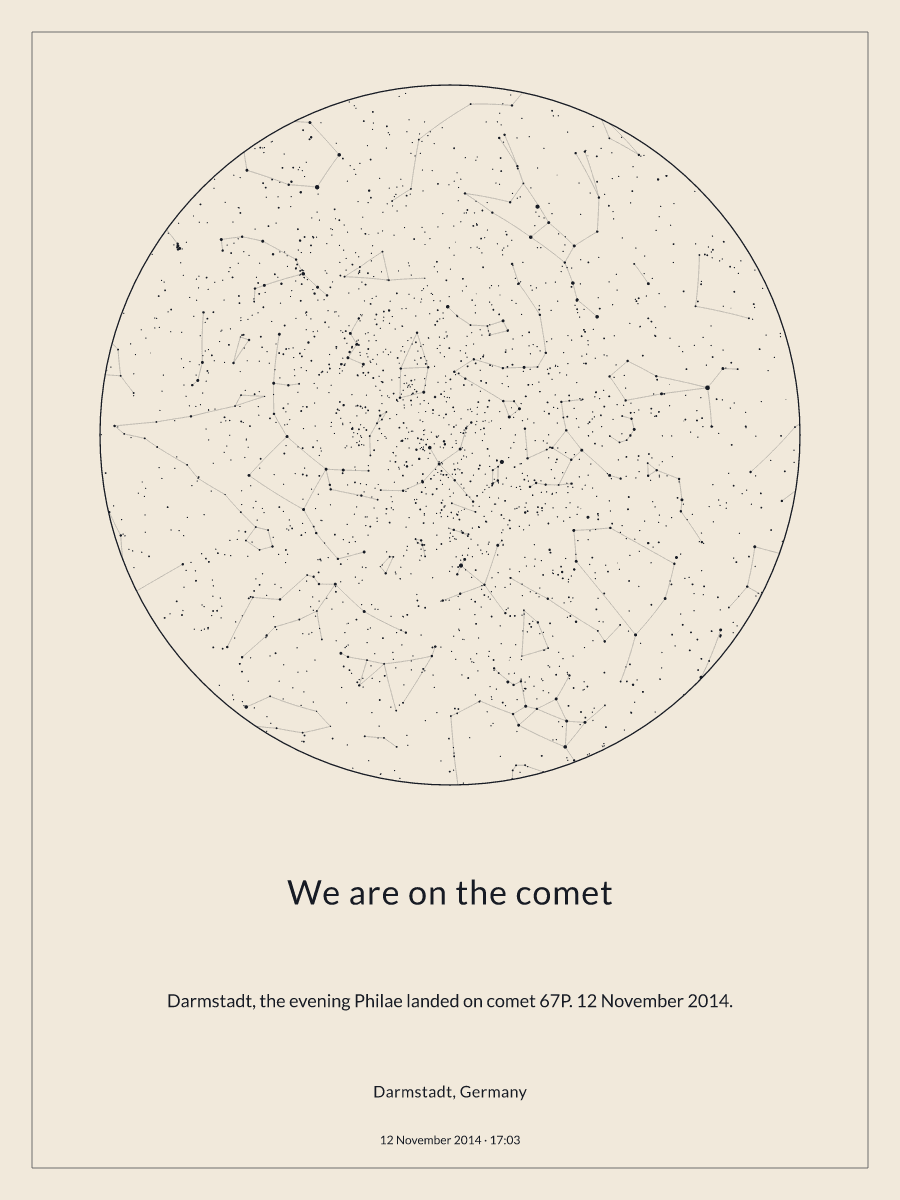
The sky above Darmstadt, Germany on 12 November 2014
The sky was still bright with twilight, so only the brightest planets and stars showed. There was a waning gibbous Moon, 68% lit, but it was below the horizon.
The sun is just below the horizon and the sky is still bright. Only the brightest planets and stars show.
- Local time
- 5:03 pm
- Time in UTC
- 12 November 2014 at 4:03 pm UTC
- Sun
- Civil twilight
- Sun position
- 3° below the horizon
- Moon phase
- waning gibbous Moon
- Moon lit
- 68%
- Moon position
- 25° below the horizon
| Planet | Visible | Direction | Altitude |
|---|---|---|---|
| Mercury | No | west | -7° |
| Venus | No | south-west | -1° |
| Mars | No | south | 14° |
| Jupiter | No | north-west | -22° |
| Saturn | No | south-west | 1° |
| Uranus | No | east | 16° |
| Neptune | No | south-east | 22° |
| Star | Constellation | Direction | Altitude |
|---|---|---|---|
| Arcturus | Boötes | west | 16° |
| Vega | Lyra | south-west | 71° |
| Capella | Auriga | north-east | 12° |
| Altair | Aquila | south | 49° |
| Deneb | Cygnus | south-east | 82° |
| Alioth | Ursa Major | north-west | 32° |
| Mirfak | Perseus | north-east | 26° |
| Dubhe | Ursa Major | north | 27° |
| Alkaid | Ursa Major | north-west | 33° |
| Polaris | Ursa Minor | north | 50° |
36 constellations are above the horizon. Highest in the sky: Cygnus, Lyra, Cepheus, Lacerta, Vulpecula, Draco, Sagitta, Hercules, Delphinus, Ursa Minor, Cassiopeia and Pegasus.
What happened that night
Philae separated from Rosetta in the morning and fell slowly towards the comet for about seven hours. Its signal took about 28 minutes to reach Earth.
The harpoons meant to hold Philae down did not fire. The lander bounced twice before it came to rest in the shadow of a cliff, where it still sent back data and pictures.
Why people remember it
Teams across Europe had worked on the mission for more than 20 years. ESA showed the landing live online, and people around the world followed it.
A star map of this evening makes a gift for a space engineer, a scientist, or a child who loves comets.
Questions about this night
It shows 5:03pm Central European Time on 12 November 2014, when the signal confirming the landing reached Earth. Philae had touched down about 28 minutes earlier.
Comet 67P/Churyumov-Gerasimenko is a comet about 4 km (2.5 miles) across. Two Soviet astronomers, Klim Churyumov and Svetlana Gerasimenko, discovered it in 1969.
ESA's mission control for Rosetta is in Darmstadt, Germany. The news that Philae had landed arrived there.