The night sky over Paris when Lindbergh landed
On the night of 21 May 1927, Charles Lindbergh landed the Spirit of St Louis at Le Bourget airfield outside Paris. He had flown alone and without a stop from Roosevelt Field on Long Island, New York.
The flight took about 33 and a half hours. It was the first solo non-stop flight across the Atlantic, and it won Lindbergh the Orteig Prize.
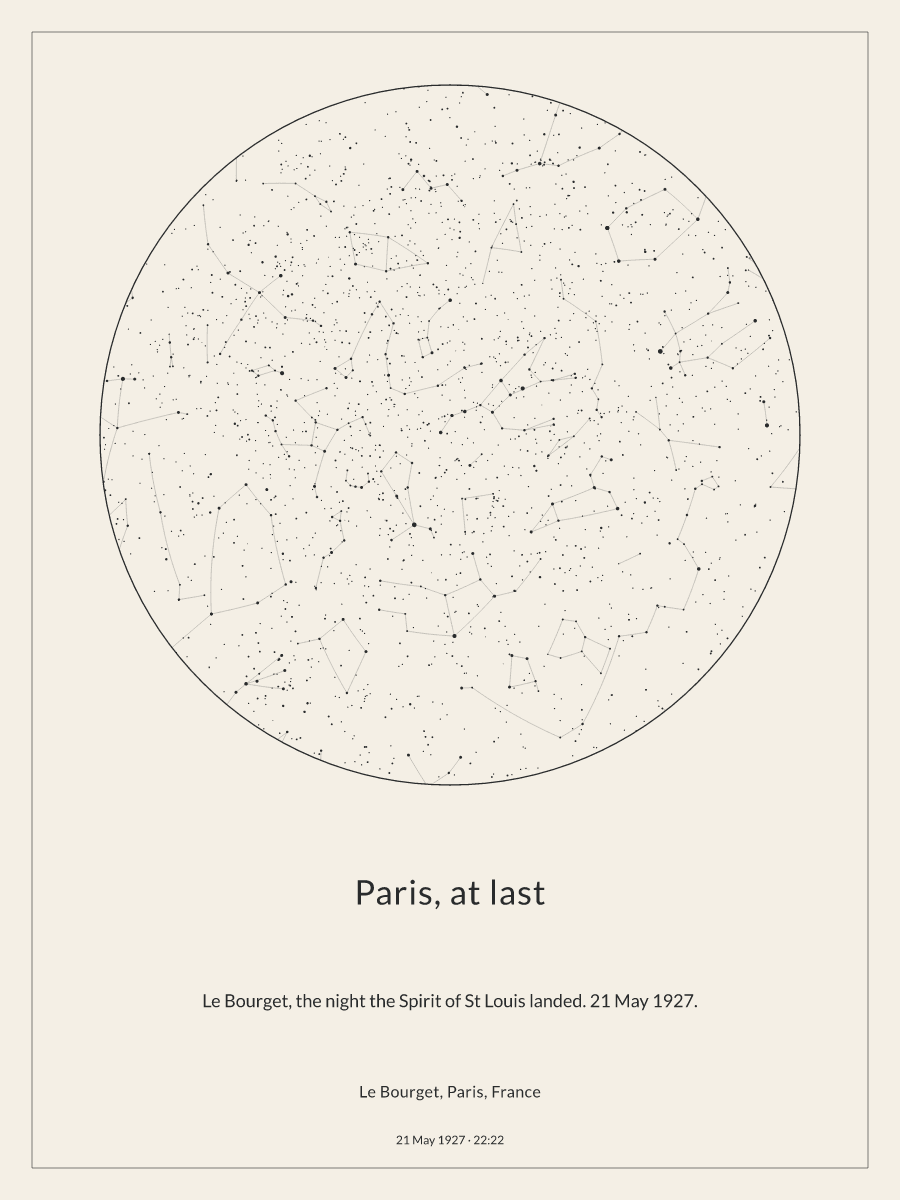
The sky above Le Bourget, Paris, France on 21 May 1927
The sky was almost fully dark, with a trace of twilight left. There was a waning gibbous Moon, 75% lit, but it was below the horizon. Venus, Mars and Saturn were above the horizon and could be seen without a telescope.
The sky is almost fully dark, but a trace of twilight still hides the faintest stars.
- Local time
- 10:22 pm
- Time in UTC
- 21 May 1927 at 9:22 pm UTC
- Sun
- Astronomical twilight
- Sun position
- 14° below the horizon
- Moon phase
- waning gibbous Moon
- Moon lit
- 75%
- Moon position
- 25° below the horizon
| Planet | Visible | Direction | Altitude |
|---|---|---|---|
| Mercury | No | north-west | -12° |
| Venus | Yes | north-west | 13° |
| Mars | Yes | west | 18° |
| Jupiter | No | north-east | -39° |
| Saturn | Yes | south-east | 13° |
| Uranus | No | north-east | -38° |
| Neptune | With a telescope | west | 33° |
| Star | Constellation | Direction | Altitude |
|---|---|---|---|
| Arcturus | Boötes | south | 59° |
| Vega | Lyra | east | 36° |
| Capella | Auriga | north-west | 17° |
| Spica | Virgo | south | 30° |
| Pollux | Gemini | west | 23° |
| Deneb | Cygnus | north-east | 23° |
| Regulus | Leo | south-west | 35° |
| Castor | Gemini | west | 24° |
| Alioth | Ursa Major | north-west | 81° |
| Mirfak | Perseus | north | 12° |
34 constellations are above the horizon. Highest in the sky: Canes Venatici, Coma Berenices, Ursa Major, Boötes, Draco, Corona Borealis, Ursa Minor, Leo Minor, Hercules, Leo, Serpens and Lynx.
What happened that night
Word of his approach spread through Paris during the evening. A huge crowd drove and walked out to Le Bourget to wait for him.
When the plane touched down, people ran across the field towards it. Lindbergh was lifted out of the cockpit and carried on shoulders before officials could get him to safety.
Why people remember it
Lindbergh became famous overnight on both sides of the Atlantic. His flight showed that long-distance flying could be practical, and interest in aviation grew fast.
A star map of this night suits pilots, aviation fans and couples with a link to both France and the United States.
Questions about this night
It shows 10:22pm Paris time on 21 May 1927, the time Lindbergh landed at Le Bourget.
About 33 and a half hours, from Roosevelt Field in New York to Le Bourget near Paris.
The plane hangs in the Smithsonian's National Air and Space Museum in Washington, DC.